I thought, well, since I have way more time in my hands than I know what to do with, I might as well start to write down full solutions for all (or at least all the nontrivial) exercises in Chapter 11 of Lee. It ended up sorta devolving into a huge tangent into cardinalities because for some reason 11.2 was very technically difficult.
Problem 1 (11.1).
(a) Suppose and are finite-dimensional vector spaces and is any linear map. Show that the following diagram commutes:
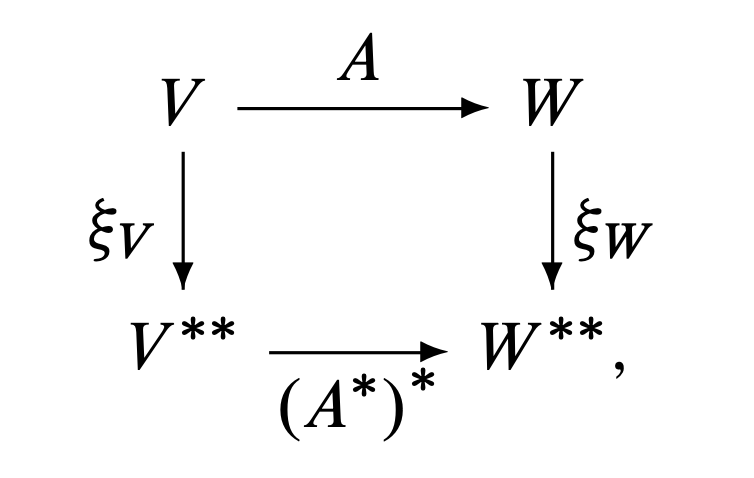 where and denote the canonical isomorphism with the double-dual space.
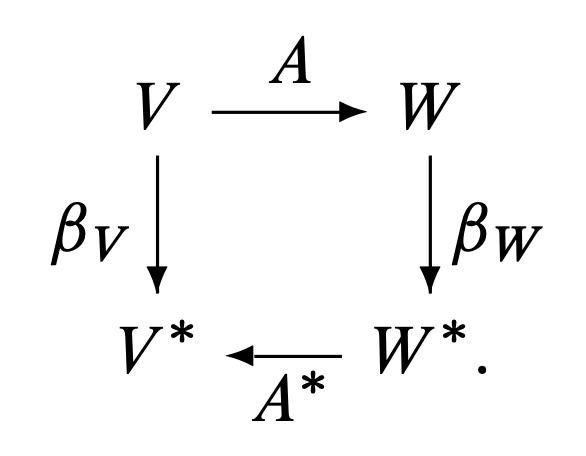
(b) Show that there does not exist a way to assign to each finite-dimensional vector space an isomorphism such that for every linear map , the following diagram commutes:
Proof) (a) is really just an annoying spell-out-definitions exercise. For any consider . For any , we have the following:
(b) Setting gives an immediate contradiction.
Before proceeding to 11.2 we prove some fundamental results on cardinalities; we keep to set-theory basics for now and don’t reach into more complex cardinality arithmetic.
Theorem 2. If is infinite and is finite, where denotes disjoint union.
Proof) Clearly, ; it suffices to show . Let be an injection. Define a map as follows: if , , if , , and for all , . This is clearly injective, and we are done.
Theorem 3. If is infinite, .
Proof) The theorem trivially holds if ; thus, a natural motivation is to partition into countably infinite sets and apply piecewise. Consider all partitions of subsets of into countably infinite subsets, with a partial order given by iff (as families). We can apply Zorn’s lemma here to obtain a maximal element ; if is infinite we can find a countably infinite subset and adjoin it to to obtain a larger family, and thus is finite. By replacing an arbitrary with , we obtain our desired partition. For any , let be a bijection, and let be the union of the s. This is clearly bijective, and thus we are done.
Remark: A free corollary of Theorem 3 is that, for any finite set , .
Theorem 4. for every infinite cardinal .
Proof) This is just a fancy way of saying for every infinite . We proceed by considering the collection
and impose a partial order on given by if and agrees with on . This set is nonempty as and has a countably infinite subset. Clearly, any chain has an upper bound which is well-defined, and by Zorn’s lemma there is a maximal element of . We claim that , which finishes the proof. FTSOC assume otherwise.
First, note that clearly , as otherwise , forcing . Therefore, there is some subset such that . We can then extend to as follows: defining , we can see that , and thus there is a bijection . Define as on and on . Then, is our desired bijection, contradicting the maximality of .
Theorem 5 (EB.5). Suppose is an infinite-dimensional vector space. Any two bases for have the same cardinality.
Proof) Let and be two bases for , and, FTSOC, assume . Any can be uniquely represented as a finite linear combination ; let be the finite subset of elements appearing in the representation of . Take ; it suffices to show that , as any element can be represented as a finite linear combination of elements of , contradicting linear independence.
First note there exists an injection as follows; well-order and , and let map to where is the smallest for which , and is the th smallest element in . Therefore, by Theorem 3, and we are done.
Problem 6 (11.2). Suppose is an infinite-dimensional vector space and is its algebraic dual space. (a) Prove that there is an injective linear map from to . (b) Prove that there is no injective linear map from to . (c) Show there cannot be an isomorphism between and .
Proof) Let be a basis for . Define a map such that is the element that sends to and all other s to ; this is clearly an injective linear map from to . (b) requires a much more intricate argument; it suffices to show there is a linearly independent set of that has cardinality equal to the power set of (all linearly independent sets can be extended to a basis by Zorn’s lemma, so this finishes the proof). We construct this as follows: first, let be the collection of finite subsets of ; clearly, . Furthermore, note that the set of size- subsets of ( is finite) satisfies by Theorem 4, and thus . We have therefore shown that .
Let be this bijection. Define such that, for any , is the functional that satisfies if and otherwise. Assume some nonzero-coefficient linear combination of for is zero, FTSOC. Ordering by set inclusion, there must be some maximal element that we, WLOG, assume is . For any there must be some element ; taking the finite subset of we can see is such that the basis element maps to while, for all , maps to . This is a clear contradiction, and thus all the s are linearly independent (this also cleanly implies injectivity). Thus, we are done as the image of is a linearly independent set of with cardinality equal to , which is strictly greater than .
The proof of (c) easily follows from (a) and (b) as the cardinality of the basis of is strictly greater than that of ; therefore, the cardinality of the basis of is strictly greater than , making an isomorphism between these spaces impossible.