First, a warmup: (Bundle Characterization Lemma) Let and be smooth vector bundles over a smooth manifold with or without boundary. A map is -linear iff there is a smooth bundle homomorphism such that for all .
Proof) The converse is trivial, so we focus on the forward direction. A natural first step is to show acts pointwise on tangent vectors. Take an arbitrary point ; let be rank and be rank .
First, assume vanishes in some neighborhood of . Taking a bump function supported in and equal to in some neighborhood of , , and thus acts locally. We must go one step further, assume vanishes at . Taking a neighborhood of and smooth local frame defined on some neighborhood of , we can represent as , where the coefficients vanish at . As all the functions and are defined on a closed set, they can be smoothly extended to functions and defined on the entirety of . Then, The vector field agrees with in some neighborhood of , and satisfies , forcing , as desired. Thus, acts pointwise on vectors.
Let be the function such that, for any , , where is any smooth section such that . is trivially linear on each fiber and covers ; it suffices to establish smoothness. Let be a neighborhood of on which there is a smooth local frame of and of defined on some neighborhood of ; obtain global smooth sections by extending to . Then, is a smooth section of , and thus there are smooth functions such that . In the coordinates induced by and , is simply matrix multiplication by ; as every component is smooth, is smooth on . As is arbitrary, is smooth.
Problem 1 (E13-1). If is a Riemannian -manifold with or without boundary, show that the unit tangent bundle is a smooth fiber bundle over with model fiber .
Proof) We first slightly generalize the smooth manifold chart lemma. Given any set and fixed , suppose we are given a cover with bijective maps where is a -manifold with or without boundary. If we have that: (a) The cover is such that for any and , and are open and is a diffeomorphism from to , (b) The cover has a countable subcover (c) For any , there is either one such that or , such that . Then there is a unique topology and smooth structure on such that each of the maps are a diffeomorphism. This easily follows from the original smooth manifold chart lemma by declaring to be smooth charts for any and smooth chart of .
For any , there is a neighborhood such that there is a local frame on ; we can use Gram-Schmidt to make this frame orthonormal with respect to . Using the coordinates induced by this orthonormal frame, we can see is diffeomorphic to . Taking all such s and diffeomorphisms gives us a structure satisfying the general smooth manifold chart lemma above. Giving the corresponding topology and smooth structure, we can clearly see it is a fiber bundle over with model fiber .
Problem 2 (E13-3). Let be a smooth manifold. (a) If there exists a global nonvanishing vector field on , then there exists a global smooth nonvanishing vector field. (b) If there exists a linearly independent -tuple of vector fields on , then there exists such a -tuple of smooth vector fields.
Proof) (a) Let be an arbitrary Riemannian metric on . It suffices to show that, for any continuous positive function and arbitrary vector field , there exists some such that, for any , . We can then apply this lemma to the nonvanishing vector field with as its -norm to complete the proof.
For any , take a neighborhood on which there exists an orthonormal frame ; let , where the functions are continuous. There exists a neighborhood of such that, for any , , and a neighborhood of such that for all . Taking , we can see that if we define the smooth local vector field on such that , for any , . Taking such neighborhoods and local vector fields for all points and linking them via partitions of unity gives us the desired smooth vector field over that is -close to .
(b) Let denote the -tuple of independent vector fields. Fix an arbitrary Riemannian metric , and let be
is clearly positive and continuous (take a local orthonormal frame); take smooth vector fields such that is -close to (by the logic in (a)). As is smooth and linearly independent, we are done.
Problem 3 (E13-5). Suppose is a Riemannian manifold. A smooth curve is unit-speed if . Prove that every smooth curve with nowhere-vanishing velocity has a unit-speed reparametrization.
Proof) Assume is an open interval. Fix a point and define a function by
As is a smooth function of and , is an injective local diffeomorphism with an open image, and thus is a diffeomorphism with some open interval . Let defined by be a reparametrization of . For any ,
and we are done.
Remark: This implies every Riemannian 1-manifold is flat as any chart can transformed, via diffeomorphism, to a unit-speed curve whose corresponding coordinate frame is (trivially) commuting and orthonormal. Remark 2: In the case that is not an open interval, simply extend it to a nonvanishing-velocity curve on an open interval, find the unit-speed reparametrization, and restrict the reparametrization.
Problem 4 (E13-9). Show that the image of given by (the helicoid ) is locally isometric but not globally isometric to the catenoid , the surface of revolution generated by the curve .
Proof) Note that the helicoid is homeomorphic to and thus has a trivial fundamental group, whereas the catenoid is homeomorphic to , and thus . Therefore, there can be no homeomorphism between and , meaning there cannot be a global isometry.
We now show is locally isometric to . Recall that the pullback metric on with its global parametrization is , and that the function defined by is a global diffeomorphism. Take any and sufficiently small neighborhood of such that taking and defining gives a local parametrization of . The pullback metric on is then , which pulls back via into , as desired. Thus, the map is an isometry from some neighborhood of to some open set of , completing the proof.
Remark: Recall that “locally isometric” is a non-symmetric property.
Problem 5 (E13-13). Let be a Riemannian manifold. A smooth vector field on is called a Killing vector field for if its flow acts by isometries of . (a) Show that the set of all Killing vector fields is a Lie subalgebra of . (b) Show that a smooth vector field on is a Killing vector field iff it satisfies the following equation in each smooth local coordinate chart:
Proof) (a) Note that is a Killing vector field iff the tensor field is invariant under the flow of ; this implies that is a Killing vector field iff . This implies the Killing vector fields are closed under scalar multiplication and addition as the map is -linear. It suffices to show that, if satisfies , then . Note that
Furthermore,
These two sides are equivalent, and thus . A general consequence of this is that, for any tensor field , . This identity is clearly sufficient for (a).
(b) is a Killing vector field iff . Isolating the component gives
We are done.
Problem 6 (E13-14). Let be the Lie algebra of Killing vector fields with respect to the Euclidean metric, and let be the subspace of such fields vanishing at the origin. (a) Show that the map
is an injective linear map from to (the Lie algebra of skew-symmetric matrices). (b) Show that the following vector fields form a basis for :
Proof) (a) This map must land in as, by 5(b), in canonical coordinates any Killing vector field must satisfy
for any at the origin at which it vanishes, forcing the Jacobian to be skew-symmetric at the origin. The map is also clearly linear; it suffices to show injectivity. We begin with the following general Lemma:
Lemma) Let be a complete Riemannian manifold and be a Killing vector field with respect to . The flow of must then be complete.
FTSOC, assume is such that its integral curve is not defined for all ; let its domain be and assume, WLOG, that . For any , note that
as is clearly invariant under its own flow and is an isometry. Therefore, for any , the Riemannian distance between and is bounded by
Thus, under the Riemannian metric the sequence is Cauchy and converges by completeness, implying exists; we call this point . By the Fundamental ODE Theorem, there exists some neighborhood of and such that for any , an integral curve is defined on . Take some such that and ; then, the integral curve can be extended, contradicting maximality.
As is complete with the Euclidean metric, the lemma implies any Killing vector field in has complete flow. Therefore, for any , is an isometry from to itself. Now, assume that is a Killing vector field such that and such that its Jacobian also vanishes at the origin. One can compute
Therefore, the matrix is invariant with time. In other words, for any , is an isometry from to itself such that and ; the only such isometry is the identity map. Therefore, must simply be the zero vector field, making the map injective as desired.
(b) It suffices to show for , is a Killing vector field; the rest is trivial. This follows from the fact that 5(b) can be straightforwardly strengthened from “each smooth local coordinate chart” to “some local coordinates around each point” as its proof is simply the direct Lie derivative computation. As 5(b) is satisfied in the canonical global coordinates of , we are done.
Problem 7 (E13-17). Let be a connected noncompact smooth manifold and let be a Riemannian metric on . Prove that there exists a positive function such that the Riemannian metric is complete. Use this to prove that every connected smooth manifold admits a complete Riemannian metric.
Proof) Let be a positive smooth exhaustion function on . It suffices to show can be chosen such that is bounded on -bounded sets; this is because any -Cauchy sequence is bounded in and must then be bounded in . As it is then contained in some compact set of , it must converge, proving completeness.
We sequentially reduce the goal of the problem until it becomes straightforward. Intuitively, we must modify such that “grows slower” than ; more precisely, it is sufficient to find such that for any , . As the LHS is a path integral, it is natural to represent the RHS as a path integral as well; in particular, for any piecewise smooth path segment such that and , .
We can modestly strengthen the goal to finding such that, for any piecewise smooth path segment , the following inequality holds:
By Cauchy-Schwarz, . Therefore, we can further strengthen our goal to finding such that, for any , . Then, for any piecewise smooth curve segment such that and , we have that
as this holds for any arbitrary piecewise smooth curve segment, this clearly implies that is bounded on any -bounded set.
We now find such an , taking note that the musical isomorphisms are metric-dependent. If we scale as and write and , for any , , implying that . Therefore, the norm becomes scaled as . In other words, we hope to find a smooth function such that for any , . The smooth function suffices.
The second part of the problem follows by letting be an arbitrary Riemannian metric and augmenting it to be complete.
Remark: If not specified refers to .
Problem 8 (E13-24). Let be a compact smooth -manifold, and suppose is a smooth real-valued function on that has only finitely many critical points , with corresponding critical values labeled so that . For any , define , , and . If and are regular values, note that and are embedded hypersurfaces in , is an open submanifold, and is a regular domain.
(a) Choose a Riemannian metric on , let be the vector field on , and let denote the flow of . Show that whenever is defined.
(b) Let be a compact interval containing no critical values of . Show that restricts to a diffeomorphism from to .
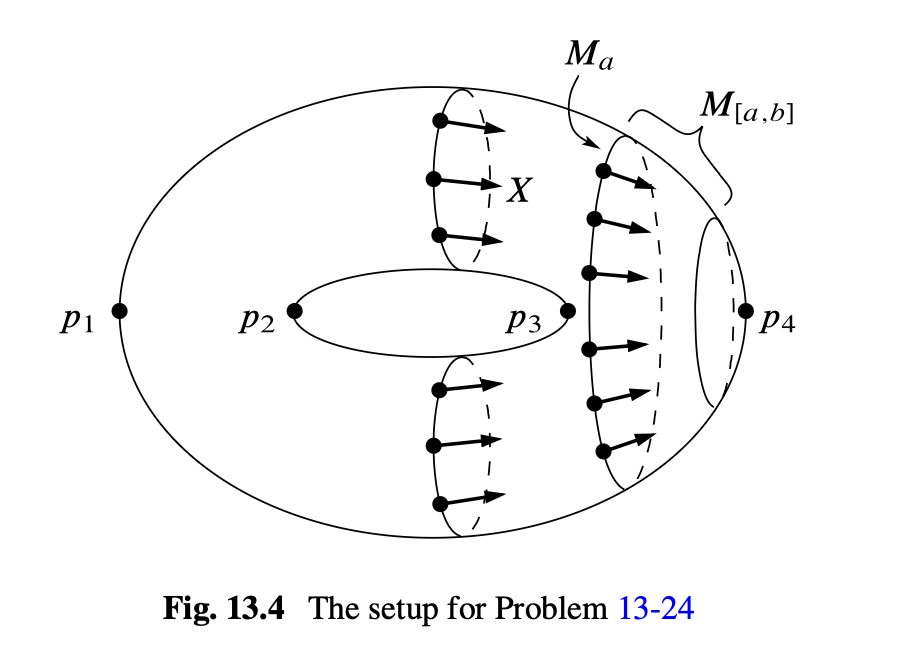
Proof) (a) follows from the straightforward computation
For (b), note that for any such that has no critical points, the set defined by is a subset of the flow domain . This is because, for any , there exists some neighborhood and constant such that . As is compact, finitely many such neighborhoods cover it, meaning there is some constant such that . Thus, an integral curve cannot end inside , forcing .
To avoid regular domain bookkeeping (which is frustrating), we simply construct the diffeomorphism and its inverse by hand. Define by with inverse defined by . Both are smooth, finishing the proof.
Problem 9 (E13-25). Suppose is a smooth manifold that admits a proper smooth function with no critical points. Show that is diffeomorphic to for some compact smooth manifold .
Proof) Take some Riemannian metric on and consider the vector field . As in Problem 8, the flow of satisfies . The flow of must be complete, as if, say, an integral curve starting at is defined on some interval with , the set is compact and thus has some such that ; thus can be extended, an immediate contradiction.
Consider the level set which is a compact hypersurface of . The restriction of to (the flowout of ) is a bijective immersion and thus a diffeomorphism. We are done.